
Herbs for Circulation and Blood Flow
What Are the Best Herbs for Circulation and Blood?
Have you ever noticed your hands and feet feeling chilly in a warm room? Or a heavy, tired sensation in your legs after a long day of standing? These can be common signs that your circulation may need extra support.
At Open Care Communityin Brooklyn, we believe one of the most empowering things you can do for your health is to understand how circulation works in your body.
Whether it is an athlete who wants to recover more quickly, a fertility patient maximizing blood flow to the pelvic floor, or just a person who wants to feel more energetic, herbs are an ancient therapy that modern research continues to explore for their role in supporting healthy circulation. We will be discussing the best herbs to use in circulation in this guide, both in a Western and an Eastern way.
Why Is Blood Circulation So Important for Your Health?
Consider your circulatory system as a highway. It is in charge of transporting oxygen, nutrients, and hormones to each of the one billion cells of your body, and at the same time, transporting metabolic waste out. When traffic flows smoothly, your body tends to feel more energized and resilient. When a traffic jam sets in, then things begin to get bad.
What happens when the circulation is poor?
When your blood flows slowly, your bodily tissues do not get the "fuel" they need. This may show up as:
Numbness or tingling in the extremities.
Slow wound healing and muscle cramps.
Digestive problems or brain fog.
In TCM, this is often referred to as "Blood Stagnation," which can cause sharp, fixed pain or menstrual difficulties.
Learn how acupuncture can help support your circulation naturally.
How does good circulation help your heart, brain, and energy levels?
Healthy circulation can reduce strain on the cardiovascular system by supporting smoother blood flow through the vessels.
What is the role of circulation in Chinese Medicine?
In Chinese Medicine, we consider the relationship between blood and qi, often described as your body’s vital energy. It is said that Qi is the governor of Blood; in other words, it is your energy that forces the blood through the vessels. When your qi is weak or stagnant, then your blood will be too. Supporting circulation is not only about the physical fluid, but it is also about having your life force be able to flow in all corners of your being.
Understanding the causes of poor blood circulation
Learn the most common reasons for poor blood circulation before we get down to the how-to. Bad circulation is not always due to one thing; it is mostly a mixture of things.
Could lifestyle habits influence blood circulation?
Modern times are characterized by a lot of sitting. Whether you are crammed on an L train to work or sitting at the desk in Manhattan, long periods of sedentary activity lead to the accumulation of blood in the lower limbs. Other contributing factors include smoking, highly processed diets, and chronic dehydration, all of which can affect vessel flexibility and blood flow.
What health conditions usually hinder circulation?
Examples include diabetes, peripheral artery disease (PAD), obesity, and Raynaud's disease. The root cause here is often inflammation, which makes the pipes of our body damaged or narrowed.
How do stress and stagnation of qi (energy) play into that?
According to TCM, our qi gets clumped when we are under stress. When we become stressed, the body goes into a fight-or-flight-mode, in fact, directing blood off the extremities, as well as our digestive organs, and to our major muscles. When this state is chronic, it sets the stage for stagnation, which makes us feel cold, tight, and exhausted.
How Can Herbal Medicine Improve Circulation?
We do not just seek to find "circulation herbs" in TCM. We ask ourselves the reason why the blood is not moving. Is there a deficiency pattern, where there may not be enough blood or energy to fully nourish the tissues? Or is it stagnant (a physical obstruction)?
What herbs are taken in TCM to enhance more effective circulation?
We have herbs called Blood Invigorators. There are mild movers, such as Rose petals, and strong movers, such as Safflower, depending on the extent of the stagnation in the patient.
We examine your tongue, pulse, and hear your history at Open Care. For example, cold hands may sometimes be linked to digestive weakness rather than a circulation issue alone.
Curious how herbs could support your specific needs? Reserve an individual herbal appointment with us
Which Herbs Are Backed by Science to Support Circulation?
Although the idea of using these plants has been around for thousands of years, modern studies are just intimately discovering their benefits. These are some of the heavy hitters to vascular health.
The Power of Plant Wisdom
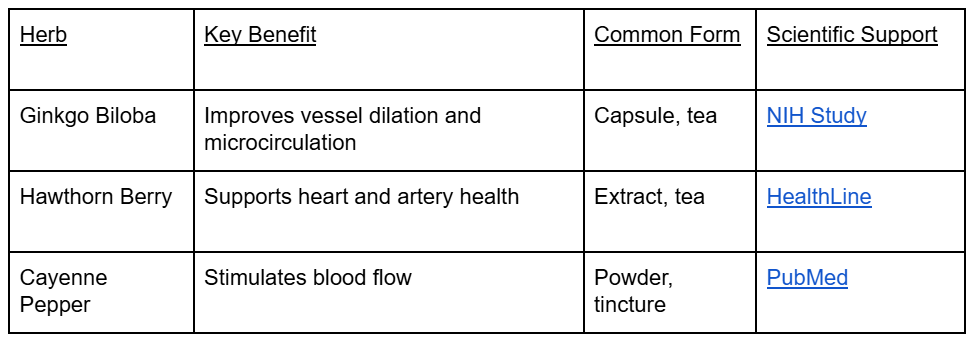
Ginkgo Biloba: Ginkgo, known as a brightener of the brain, works by opening up the blood vessels and causing the blood to be less sticky. Studies suggest it may support peripheral circulation, particularly in the hands, feet, and brain.
Garlic: Garlic contains allicin, a compound studied for its role in supporting healthy blood vessels. Cayenne pepper has also been researched for its potential effects on circulation and cardiovascular health. It acts as kick-starter to your heart and veins.
Hawthorn Berry: the berry of a natural heart tonic. It helps to increase the quantity of blood which is pumped by the heart when it contracts, in addition to strengthening the walls of the vessels.
Turmeric: Its active constituent, curcumin, is a potent anti-inflammatory. It is taken to enhance the circulation of the blood in the vessels (the endothelium) that already exist by decreasing inflammation in the blood vessel lining (the endothelium).
Best Circulating-Boosting Herbs and Their Main Benefits.
What Are the Most Common Chinese Medicine Herbs to Enhance Circulation
Dang Gui: This is fertility and menstrual ingredient primarily.
Dan Shen (Salvia miltiorrhiza): This is also one of the most widely studied herbs of the cardiovascular field. It helps cool inflammation and dissolve stagnation in the area of the chest and heart.
Chuan Xiong (Ligusticum wallichii): It particularly moves qi and blood up to the head, hence it is applied in most forms of headaches.
Hong Hua (Safflower): It is considered a strong blood-moving herb in Chinese medicine. This is applied to loosen up blood stasis, such as when an injury has taken place.
The Power of Formulas: We do not simply use one herb in TCM. We combine them in formulas, in which the herbs will cooperate. Some herbs will circulate the blood, others will go to the stomach, and others will carry the medicine to the correct parts of the body, for example.
Herbal medicine should always be used under the guidance of a licensed practitioner, especially when managing chronic conditions or fertility care. Our team is happy to help.
Can Acupuncture and Herbal Medicine Collaborate?
Yes. Acupuncture needles are the physical stimulus of the nervous system that triggers the flow. In the process of inserting a needle, needle insertion creates a localized response that may encourage circulation and nervous system regulation. Systemically speaking, it assists in turning the switch of a stressed system to a repaired one, so that the blood vessels can dilate naturally.
Why should they be used together?
We can use both to treat the circulation both inside and outside. Always tell your practitioner whether you are taking heart medication or have an operation scheduled.
At Open Care, we offerCommunity Acupuncture and Private Acupuncture to fit your needs. Book Now
Not all supplements are beneficial for everyone
Some herbs (such as Hong Hua) are contraindicated during pregnancy or when taking medications such as warfarin. We also source our formulas from reputable companies that test their herbs for heavy metals and purity.
When Should You See a Practitioner regarding Circulation Problems?
If you notice any of the following red flags, it’s important to seek medical attention promptly:
swelling in one leg suddenly.
chest pains or sudden breathlessness.
sore feet or legs that do not heal.
In chronic conditions such as cold limbs, varicose veins, and slow recovery after exercise, the holistic treatments are a great addition to your primary care needs. During an Open Care consultation, we will examine your lifestyle, nutrition, and history and create a plan that you can sustain daily:
Gentle Movement: You do not need HIIT training. Walking, yoga, or Qigong (gentle energy work) will pump up the lymphatic system and blood.
Warmth: When cold, your vessels will shrink.
Hydrotherapy: After taking a shower, you can warm your feet with comfortably warm water, then briefly switch to cooler water to gently stimulate circulation.
Our downtown Brooklyn clinic is designed to be a place where you feel truly listened to and supported. We evaluate your circulation through the prism of the Western physiological approach and the Eastern approach to energy to make sure that you can afford the frequency of your care so that you can start seeing the results.
Frequently Asked Questions: What Patients Should Know about Herbs and Circulation
Q: How soon will I feel better?
In the case of a cold pattern, you will feel warmer in the days. On more long-term problems, such as varicose veins or blood pressure, we usually consider a window of 3 months of regular herbal and acupuncture support.
Q: Can I take herbs with my blood pressure drugs?
Not all of them. Always consult your practitioner and doctor before doing so.
Q: Which herbs are safe for fertility?
Dang Gui is a popular one, but timing is crucial. Our speciality is to make formulas specific to patients undergoing IVF or naturally trying based on their pattern.
It can be as simple as the acupuncture needle poking your finger, or a cup of herbal tea warming your hands. We are here to assist you in starting your flow again.
[Book your acupuncture intake or herbal consultation today.
