Natural support for prostate health: a TCM approach
How Can Traditional Chinese Medicine Support Prostate Health Naturally?
Prostate health concerns often develop gradually, which is why many men don’t notice them until symptoms begin affecting daily life. It may start with more frequent urination, pelvic discomfort, or subtle changes that are easy to dismiss at first. In most cases, the initial signs can be very mild; thus, they can easily be neglected. However, as time goes by, it becomes increasingly difficult to ignore them.
At Open Care Community, many patients exploring prostate health support are also looking for approaches that focus on long-term balance rather than symptom management alone.
Traditional Chinese Medicine (TCM) approaches health holistically, looking at how different systems in the body influence one another. The prostate gland is not treated in isolation; the focus is on the function of the entire body, including the person's energy, blood circulation, stress management, digestive processes, and many other factors.
What Is Prostate Health and Why Is It Important?
While being a very small gland, the prostate plays an essential part in the male reproductive system. It contributes to the creation of the seminal fluid and affects its functioning in more ways than you might even think about until problems arise.
Some of these problems may include:
BPH: Prostate enlargement, usually associated with urinary disorders
Prostatitis: Inflammation that can be painful for a patient
General urinary changes: Frequency, urgency, or interrupted flow
These concerns are common, but that doesn’t mean they should be ignored.
How Does Traditional Chinese Medicine View Prostate Health?
In Traditional Chinese Medicine, the prostate is viewed as part of a broader network of body systems, such as the Kidney System, which is associated with energy, life cycle, and reproduction. The terms used in relation to the Kidney System include:
Qi: The energy that drives all processes in the body
Yin and Yang: The balance between the cold/warming, resting/active aspects of the body system
According to TCM principles, balanced qi supports healthy function, while imbalance may contribute to symptoms over time. Below is an easy way to distinguish one from another:
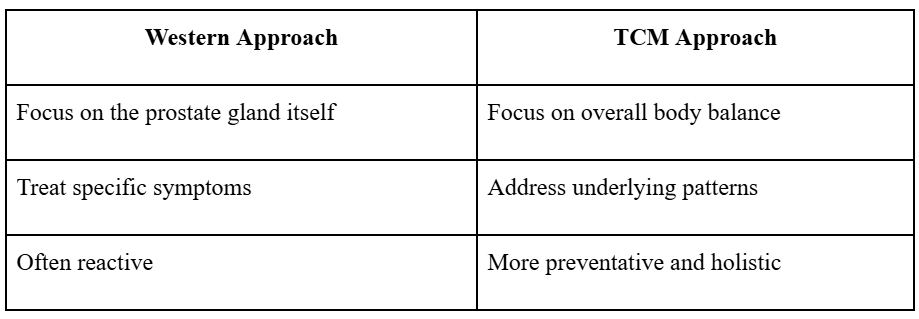
This doesn’t mean one replaces the other. Many patients use both approaches together.
What Are the Key TCM Treatments for Prostate Health?
TCM typically combines multiple therapies to support prostate health in a more comprehensive way.
How Can Acupuncture Benefit Prostate Health?
Acupuncture involves placing very thin needles at specific points in the body to support circulation, nervous system regulation, and overall balance.
From a modern clinical perspective, acupuncture may help:
Enhance circulation
Lower levels of inflammation
Facilitate nervous system regulation
For any issues related to your prostate, the enhanced circulation in the pelvic area would play a crucial role. Some research studies have analyzed the use of acupuncture for alleviating symptoms of chronic prostatitis. While results vary between individuals, some studies suggest acupuncture may help reduce discomfort and improve the quality of life for certain patients.
Many patients at Open Care Community describe acupuncture sessions as calming and deeply relaxing.
How Can Herbal Medicine Support Prostate Function?
Herbal medicine is another important part of Traditional Chinese Medicine. Rather than using a one-size-fits-all approach, herbal formulas are typically tailored to each patient’s symptoms and overall health patterns.
Some of the commonly prescribed herbs for prostatic and urinary issues include:
Saw Palmetto: Commonly linked to urinary flow support
Pygeum: Commonly prescribed for symptoms related to the prostate gland
Rehmannia: An herbal remedy that boosts kidney qi
In TCM, herbal prescriptions are formulated using a combination of herbs according to your symptoms and body type, rather than single herbs.
Can Lifestyle and Dietary Changes from TCM Aid Prostate Health?
TCM also places strong emphasis on how daily habits influence long-term health. Some basic suggestions may include:
Staying warm: Especially around the lower back and abdomen
Reducing excessive caffeine and alcohol: These can irritate the bladder
Eating balanced meals: Warm, nourishing foods are often emphasized
Managing stress: Chronic stress can disrupt multiple systems
While these adjustments may seem simple, they have a profound effect on balance and well-being over time.
How Does Open Care Community Implement TCM for Prostate Health?
At Open Care Community, treatment plans are personalized based on each patient’s symptoms, lifestyle, and overall health goals. Thus, there isn’t any universal protocol for treating prostate conditions; instead, it begins with communication.
What Does a Personalized Approach Look Like?
On your first visit, your provider will ask questions regarding:
Symptoms
Sleep
Digestive function
Stress level
Lifestyle
After that, an approach may consist of:
Acupuncture treatment
Herbal treatment
Making slight changes in your life
The goal is not only symptom relief, but also supporting the body’s overall balance and function.
What Makes Open Care Community Unique in Its Approach?
First of all, the setting itself tends to stand out to patients.
The sliding-scale payment system ($50-$90) increases accessibility
There’s no need to verify income; patients choose what they can afford
The clinic is designed to feel welcoming, supportive, and accessible.
In addition to the treatments themselves, some patients enjoy the communal acupuncture experience. The quiet, shared space may be grounding for people accustomed to a more clinical setting.
Many patients also appreciate the clinic’s emphasis on listening and individualized care. They say that they’re being heard rather than rushed or talked over.
Interested in exploring TCM for prostate health? You can book a consultation at Open Care Community.
Are There Any Risks or Contraindications with TCM for Prostate Health?
Like any form of care, TCM should be approached thoughtfully and with professional guidance.
Acupuncture is a generally safe treatment modality as long as it is undertaken by a qualified practitioner. Side effects are generally mild and may include temporary soreness, bruising, or fatigue.
It is crucial to:
Provide the complete history of one’s health
Inform about any medication taken
Engage one’s physician in the treatment process if necessary
TCM is often most effective when integrated into a broader healthcare approach.
Conclusion: Taking a More Holistic Approach to Prostate Health
Prostate health support often starts with paying attention to subtle changes early on. It all comes down to listening to your body from the beginning and providing ongoing support.
One possible way to do so is by seeking Traditional Chinese Medicine treatment, which takes a unique perspective on the issue.
Instead of considering individual symptoms, Traditional Chinese Medicine assesses the way energy, blood flow, and your overall balance work together.
For many patients, improvements happen gradually through consistent care and lifestyle support. Rather than promising quick fixes, TCM focuses on steady progress and long-term balance. It’s possible that this is something you should explore.
To learn more or schedule an appointment, visit Open Care Community.
