Medical Massage in Brooklyn: When It’s the Right Choice
When Is Medical Massage the Right Choice for You?
Life in Brooklyn keeps you moving. Whether you’re rushing for the subway near Borough Hall, training for the Brooklyn Half, or spending long hours at a desk, your body absorbs the strain. Over time, that constant pace can start to show up as tension, stiffness, or pain.
Curious whether a rubdown might do more than ease stress now and then? Perhaps you've thought about it helping heal injuries, bringing back movement that's gone missing, or easing long-term soreness. Chances are, you're not the only one thinking this way.
A spa massage can feel relaxing, but it’s not designed to address specific physical concerns. Instead, medical massage aims at particular physical problems with clear goals. At Open Care Community in downtown Brooklyn, we believe hands-on care should be accessible and grounded in real therapeutic goals—not reserved for a select few.
In this blog, you'll discover what medical massage really means, why it's not like regular Swedish style rubs, and how picking it could help your wellness path.
Curious about hands-on care built around you without breaking the bank? Check out what we offer at Open Care Community right now.
What Is Medical Massage and How Does It Differ from Regular Massage?
To pick what’s right for you, knowing the terms helps. Medical massage isn’t a single method like Deep Tissue or Shiatsu; instead, it’s a broad label showing the purpose behind the treatment.
How do professional organizations define medical massage?
Per organizations such as the AMTA, medical massage focuses on results. So therapists use tailored techniques that match the patient’s exact issue.
In a spa, people typically just want to unwind and feel less stressed. At our clinic, though, it’s more about easing pain, improving movement, or healing injuries. Sure, you might relax during a medical massage, but that calm feeling comes as an added benefit of the work, rather than its sole purpose.
In New York, this difference matters since medical massage usually fits into a broader care routine, often paired with a doctor’s or chiropractor’s assessment. While one supports the other, they don’t replace it.
What’s the usual way therapists handle muscles tied to health issues?
Therapists pick techniques depending on what your body does. These can include using gentle pressure instead of deep touch, trying slow movements rather than quick ones, mixing breath work with light stretches, swapping usual poses for easier versions, and adjusting timing to fit your pace.
Applying focused pressure to sensitive muscle points can help reduce pain that radiates elsewhere in the body. This approach targets areas of tightness linked to overuse or restricted movement. The goal is better motion through quieting sensitive areas. Easing stress in these trigger zones usually brings comfort.
Myofascial Release: Gentle pressure on stiff areas - this helps reduce pain, yet improves mobility.
Neuromuscular Therapy: a hands-on approach that tackles pain and motion problems by working on sore areas, tense muscles, or stiff tissue - not broad strokes. It uses precise pressure, not typical rubs. The strength changes depending on how the person responds, not fixed rules.
Cross fiber friction of the muscle - this eases stiff or hurt zones. Go perpendicular instead of along the fibers, helping release knots with repeated motion.
Tui Na: A type of traditional Chinese massage, available here, that targets clear imbalances in your system.
Does insurance pay for medical massage, or can you use HSA or FSA money instead?
Navigating healthcare expenses in NYC isn't always straightforward. Although regular relaxation massages usually aren't included in coverage, medically prescribed ones are treated separately.
Many people are able to use HSA or FSA funds for medical massage when it is considered medically necessary, often with documentation from a healthcare provider.
In New York, certain health plans might cover massage costs when a doctor or chiropractor recommends it. Check your plan’s fine print, or head to healthcare.gov, where you can learn what counts for HSA or FSA use.
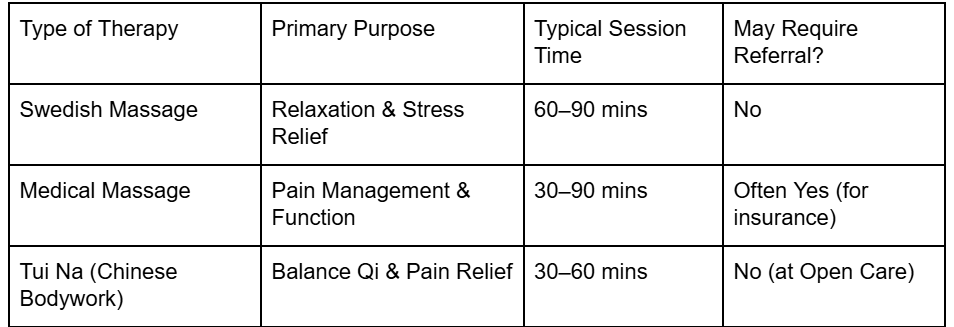
Quick Comparison Guide:
When Should You Consider Medical Massage in Brooklyn?
When regular massages no longer help, switching to something more targeted could spare you hassle. Trouble that won’t quit, even after rest or basic stretches, might mean it’s smarter to try a professional treatment instead.
Who might feel better with a therapeutic rubdown?
Many folks visit, hoping to ease stubborn health issues. This type of therapy works well because it targets problem areas directly:
Chronic back or neck pain: Commonly worsened from staring down at screens too much or slouching in chairs all day.
Sciatica: Easing nerve strain by focusing on your glutes, also working the lower back carefully.
Repetitive strain injuries: Pop up a lot; office folks might get carpal tunnel, while those in hands-on jobs face similar issues.
Tension headaches? Loosen up your jaw, ease the neck tightness; simple moves help quiet that ache. Try slow stretches instead of clenching through it; relief’s closer than you think.
Fibromyalgia: Soft, targeted moves might lower discomfort cues; using slow pressure or steady touch could make a difference while helping ease tension without strain.
Anxiety tenses up your body: Suddenly, your shoulders tighten like knots while the chest feels heavy. Stress doesn’t just live in the mind; it grips muscles without warning. One moment you're fine, the next, every breath seems stuck under pressure.
Here’s a tip: try mixing medical massage with acupuncture; it often works better together. Got tough pain? Talk to your therapist about using both methods at once, one for muscles, the other for balancing Qi.
Does medical massage work for healing after surgery or getting over an injury?
Research suggests massage may support recovery by helping reduce swelling and supporting cellular energy processes, according to findings published by the National Institutes of Health.
For post-surgical patients (once cleared by a surgeon), medical massage helps by:
Less scar tissue: Dissolves tight spots limiting motion.
Boosting flow: Oxygen-packed blood reaches damaged spots faster, helping healing kick in. Blood moves better when circulation improves, so tissues heal themselves quicker. Getting more nutrients where they’re needed means less downtime after injury.
Lymphatic Drainage: Reducing swelling (edema) is common after surgery or injury.
What training does a massage therapist need to work in NYC?
In New York State, you need a license to work as a massage therapist; it’s handed out by the Office of Professions (keep an eye out for the "LMT" tag). A practitioner may only be licensed after completing 1000 hours of education and taking a State Board Licensing exam.
For medical massage, it’s important to work with a therapist who has advanced training beyond standard licensure.. Some of our therapists specialize in areas like orthopedics or getting athletes back on track; others use methods from traditional Chinese healing, such as Tui Na or Gua Sha. That way, you know your care is handled by pros who are certified, well-trained, and focused on safety.
All Open Care Community healers are licensed and skilled in hands-on therapy. Try a no-cost chat now so you can talk through what you're dealing with.
How Does Medical Massage Fit Into a Holistic Treatment Plan?
One thing that sets Open Care Community apart? Seeing the body like a web of linked parts. Not focused on symptoms alone; instead, we pay attention to everything about you. While others rush to fix one issue, we step back to see how it all fits together. Because real care means looking beyond quick fixes.
Massage focuses on muscles, connective tissue, and soft areas; meanwhile, acupuncture targets nerves along with energy pathways, called meridians in traditional Chinese healing.
Take, say, ongoing lower back discomfort:
Massage helps loosen stiff lower back muscles through touch.
Acupuncture boosts circulation while triggering natural painkillers, breaking the loop of discomfort.
Tui Na works like a link, applying hands-on methods that help Qi, your life force, move freely across the region.
We’ve also got cupping and gua sha, traditional methods that work well to clear stuck energy from muscles while moving new blood up toward the skin.
Could massage help when trying to conceive or ease daily tension?
This question pops up a lot. Trying to get pregnant, on your own or with IVF help, often feels overwhelming. When you're stressed, your body makes more cortisol. That hormone can make muscles tense, slowing down circulation. Acupuncture should be the number one modality to support this goal. However, in addition,
Medical massage supports fertility patients by:
Reducing stress hormones helps your body move out of survival mode into calm recovery so it can relax and process properly.
Boosting circulation into the belly plus lower torso.
Blending massage alongside our fertility acupuncture routines helps build a calmer, more welcoming state inside the body.
Where Can I Find Affordable, High-Quality Medical Massage in Brooklyn?
Medical care costs a lot, yet staying healthy in New York doesn’t have to be hard. Our goal is to make it more affordable.
What’s worth checking out when picking a local massage therapy spot?
ADA Accessible: Does the place feel open to everyone, no matter their physical needs?
Pricing you can see through: Do fees stay tucked away, or show up right at the start?
Check if your massage therapist talks with acupuncturists or herbalists: Does that help your overall wellness? Coordination might make a difference.
How does Open Care Community make healing therapies accessible?
Access to quality care should not require choosing between health and basic living expenses. Bodywork or community acupuncture costs between $50 and $90, depending on your budget, with an additional $15 for your first visit. 60 minute Massage Therapy sessions cost $160.
Find us here:
We’re right in the heart of downtown Brooklyn, easy to get to, close to transit, tucked near local shops.
44 Court Street, Suite 1000 (10th floor), Brooklyn, NY 11201 (ADA friendly - reachable by bus or train)
What if you could focus on feeling better without spending too much? See why hands-on care at Open Care Community helps people move more easily. Grab your spot now using their website.
What Questions Should I Ask Before Booking a Medical Massage?
Figuring things out begins by wondering what’s missing. Our goal? Helping you trust your choices.
What should I do before my first visit?
The paperwork: Get set to complete a medical background sheet. Share every medicine and issue truthfully; this way, we can protect your well-being.
Clothing: Go for relaxed fits that feel easy on the body. When it’s Tui Na or group acupuncture, staying dressed is common. If it’s a treatment using oils, you’ll be well-covered; only the area being worked stays exposed.
Stay hydrated: Sip water ahead of your visit. When muscles hold enough fluid, they react well to therapy.
What kind of outcome should I look for, and what’s my way to track it?
Medical massage focuses on outcomes. When beginning, talk to your therapist:
"Based on my symptoms, how many sessions do you think I might need?"
What’s our way to check how things are going? Like better movement or less pain reported.
If you’re not better right away, no stress. Long-term problems usually need several sessions before they clear up. Keep us in the loop; share what’s helping, along with what’s falling flat.
How Can Medical Massage Complement My Athletic Training or Gym Routine?
Brooklyn’s streets buzz with runners, cyclists, even weekend hikers; some sprint through Prospect Park while others tackle ropes and weights down in DUMBO; you’ll spot them near old warehouses turned gyms where music thumps at dawn.
Could a rubdown help you bounce back after exercise?
Yep. Tough workouts create tiny rips in your muscle strands; this actually makes them stronger, but they leave behind stuff like lactic acid. A good rubdown pushes that gunk out, which means less soreness later on.
Muscle recovery gets a boost because massage calms the mind, slowing down heartbeat while also helping you sleep more deeply; this downtime lets your body make more HGH naturally.
Do busy New Yorkers need medical massage to avoid getting hurt?
If you’re getting ready for a race or big workout, medical massage helps keep injuries away. Because it loosens up connective tissue while balancing muscle tension, your body doesn’t start moving wrong under stress. Say your calf muscles get stiff; they can trigger heel pain down the line. Fixing them early means less trouble in your feet later on.
See what we offer in sports medicine; our approach mixes orthopedic acupuncture with trigger point work to help you stay sharp.
Conclusion
Medical massage is not simply about relaxation; it plays a meaningful role in supporting mobility, function, and pain management. If you're healing after an operation, aiming to get pregnant, or shaking off stress from a hectic week, this kind of therapy helps your body reboot.
AtOpen Care Community, you’ll find people who pay attention - caring support that’s fair, plus services designed to match what you can afford.
If you’re ready to explore whether medical massage is right for you, we’re here to help.
Come see us at 44 Court Street - or just reach out to grab a spot.
Mail: info@opencarecommunity.com
Call at (917) 426-1138
