TCM Fertility Herbs: Supporting Reproductive Health
The Role of Traditional Chinese Medicine (TCM) Fertility Herbs in Reproductive Health
For many people, the journey toward expanding a family is both hopeful and deeply stressful. Whether you are beginning to consider pregnancy or navigating assisted reproductive technologies such as IVF (in vitro fertilization) or IUI (intrauterine insemination), fertility is less a purely scientific process and more a reflection of overall balance within the body.
Traditional Chinese Medicine (TCM) has supported reproductive health for over 2,000 years and is increasingly recognized today as a complementary, evidence-informed approach alongside Western fertility care. AtOpen Care Community, in downtown Brooklyn, we believe healthcare is a human right. Our licensed acupuncturists and herbalists provide gentle, inclusive care that respects both clinical insight and lived experience.
Curious how herbal medicine may support your reproductive health? Make a herbal appointment at Open Care Community
What Is Traditional Chinese Medicine (TCM) and How It Perceives Fertility?
Western medicine tends to understand fertility in terms of hormones, follicle count, and structural health. Although TCM does not ignore these factors, it does not focus on each factor individually. Instead, TCM considers the body as an interconnected ecosystem, where fertility reflects the health of the whole system rather than a single isolated factor.
What is the holistic understanding of reproductive health by TCM?
TCM is founded upon the concept of balance. There are several important concepts that we discuss when we are discussing fertility:
Kidney Jing (Essence): Often described as a “reproductive savings account,” Kidney Jing represents inherited vitality that governs growth, development, and reproduction.
Blood: In TCM, Blood refers not only to circulation but to the nourishment required to support a healthy uterine lining and sustain pregnancy.
Qi (Vital energy of your body): Qi (pronounced “chee”) represents the body’s functional energy. When Qi becomes stagnant, often due to stress, circulation to the reproductive organs may be affected.
Yin and Yang: These are the cooling/ moistening and warming/ activating forces, respectively, within the body. Both must remain in balance to regulate the menstrual cycle and support healthy sperm production.
TCM assessment extends beyond lab results. Pulse reading, tongue observation, and a detailed health history help form a complete diagnostic picture.
What are the differences between TCM and Western fertility models?
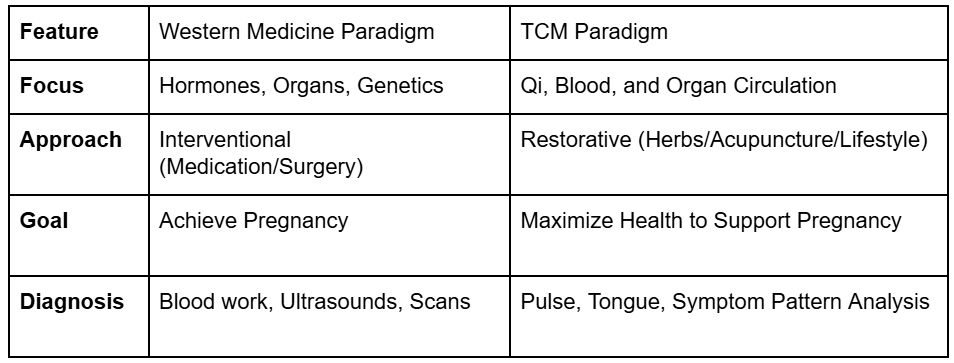
When these two systems work together, outcomes are often strongest. TCM does not replace your reproductive endocrinologist—it supports the body so medical interventions have the best possible conditions to succeed.
What Are the TCM Herbs That Are Used to Aid Fertility?
In Chinese medicine, herbs are rarely prescribed individually. They are combined into formulas designed to work synergistically, with each ingredient complementing one another.
What are the most widespread Chinese fertility herbs?
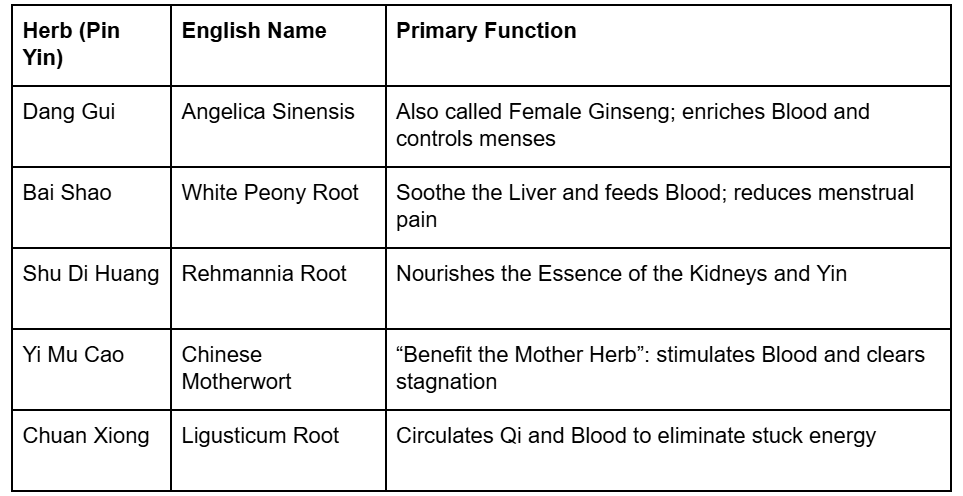
Gender-Inclusive Benefits:
These herbs are not limited to gestational fertility support. Gou Qi Zi (goji berry) and Tu Si Zi (dodder seed) are commonly used to support sperm count, motility, and morphology by nourishing Kidney Yang.
What can TCM Herbs do to help Assisted Reproductive Technologies (IVF/IUI)?
When you are in the middle of the IVF or IUI procedure, you might question whether herbs are excessive for your body. When professionally managed, herbal therapy can play a supportive role during fertility treatment.
Is the combination of TCM and IVF or IUI safe?
Yes, but timing is everything. Herbs are frequently used during the preparation stage (3-6 months preceding a cycle) to enhance the quality of eggs and Spermatozoa. At this active stimulation phase of IVF, we tend to hold back the herbs and replace them with acupuncture to ensure no interference with the large doses of hormones prescribed by your doctor.
What are the research findings of TCM herbs and fertility rates?
Research has indicated that TCM (acupuncture and herbs) may be used in combination with Western ART to greatly enhance the results. According to ameta-analysis study published in the journal Complementary Therapies in Medicine, Chinese herbal medicine has the potential to increase the pregnancy rate by 2 times in the 4 months as compared to the use of western medical drugs alone.
TCM herbs can assist patients having IVF by:
Controlling the menstrual cycle such that a window is predicted.
Increasing the quality of eggs and Spermatozoa is through alleviation of oxidative stress.
Supporting circulation and uterine receptivity during implantation.
The decrease of stress and cortisol that otherwise causes lessening of blood flow to the pelvis.
Are TCM Herbs health-safe during Fertility and Pregnancy?
Safety is our top priority. Herbs are powerful medicines and must be used with professional oversight.
Who must not take some herbs?
Some herbs are invigorating, that is, they push the blood vigorously. They are wonderful in a person attempting to control a cycle, and are contraindicated (unsafe) once a person is literally pregnant or, if they have certain autoimmune diseases. This is the reason why we follow up with our patients and change formulas immediately when a positive test is observed.
What are the things that patients need to know about sourcing and quality?
Herbs are not made equal. In the Open Care Community, all herbs are only GMP-certified (Good Manufacturing Practices). All herbs used at Open Care Community are sourced from GMP-certified suppliers and tested for heavy metals, pesticides, and contaminants. Purchasing fertility tea online, without verifying the supplier, may be a dangerous proposition since no one knows the purity or dosage.
What are the side effects or interactions of herbs and drugs?
Side effects are uncommon and mild in nature and usually disappear after a short time under the supervision of a professional. Herb-drug interactions are the biggest concern, especially with the blood thinners. We will continuously support the free flow of information between your herbalist and your Reproductive Endocrinologist.
When Should You Think TCM Herbal Therapy is the Answer to Fertility?
Most of the patients visit us when they believe that they have reached a dead-end in Western diagnostics. TCM may prove especially useful in:
Abnormal ovulation (Amenorrhea or painful periods).
PCOS or Endometriosis (Healing inflammation and insulin sensitivity).
Repeated abortion (Strengthening the "holding" capacity of the Uterus).
Premature infertility (Balancing the delicate mechanisms that are not detected by the laboratory).
Low sperm count or motility.
Perimenopausal fertility support (Optimizing the eggs that are left).
Could the same-sex couples or trans patients be beneficiaries of the TCM herbs?
Open Care Community is a judgment-free, LGBTQ+-affirming clinic. Whether you’re pursuing reciprocal IVF, working with a gestational carrier, or navigating fertility alongside gender-affirming care, our herbal plans are adapted to your individual goals.
How long does the duration of the herbal therapy usually last?
Egg development and sperm production typically occur over a 90–120 day cycle. Due to this biological schedule, we tend to suggest that at least 3 months of regular herbal and acupuncture therapy should be used to experience the most changes in reproductive quality.
What is an herbal consultation supposed to be like?
We talk about your sleep, digestion, level of stress, and menstrual history. We examine your tongue and pulse to identify your TCM pattern. It is based on that that we develop a tailored plan that fits your budget and lifestyle.
Who will be guiding my care?
Our practitioners are licensed acupuncturists and herbalists with extensive clinical training and experience. We blend medical practice and a community philosophy. With sliding-scale pricing ($50–$105, plus $15 for the initial visit), we ensure fertility care remains accessible—not exclusive.
TCM herbal medicine provides a moderate, time-tested method of supporting reproductive health. These ancient formulae prepare the soil for a healthy pregnancy by paying attention to the balance of Qi, Blood, and Essence. Personalized herbal care can be utilized either independently or in combination with IVF, as it gives you the power to nurture your body internally.
Begin your fertility journey with our team of friendly and experienced herbalists.
Schedule a sliding scale check-up at Open Care Community now
