Fertility-Supporting Herbs for Natural Conception: A Chinese Medicine Perspective
The path to parenthood is often described as a marathon rather than a sprint. For many people, it can feel like navigating complex emotional terrain without a clear roadmap—whether you’re just beginning to think about starting a family or have already spent years moving through fertility treatments and medical care.
At Open Care Community, in downtown Brooklyn, we understand that fertility care is not defined by lab results alone. Behind every chart is a real person, with a story, a body, and a nervous system shaped by lived experience. Our integrative approach centers on respecting the wisdom of your body while drawing on time-tested principles of Traditional Chinese Medicine (TCM) alongside evidence-informed herbal care. This guide will enable you to know how particular herbs can assist in maintaining your reproductive health, equalizing your system, and quite possibly prepare your own body for conception.
What Can Herbs Do to Facilitate Fertility in Traditional Chinese Medicine?
Fertility is viewed in Western culture as hormone levels and the number of follicles. Although they are critical, Traditional Chinese Medicine provides a wider view of fertility as a product of the general state of the body that can be described as a climate. When the soil is fertile, and the surroundings are well balanced, the seed stands a better chance of being rooted.
What Does Balancing Qi Mean for Reproductive Health?
You will always hear us refer to Qi in our clinic (we pronounce Qi as chee). In a nutshell, Qi is the vital energy of your body. In the case of fertility, we seek out so-called Qi stagnation, that is, when the energy does not flow into the reproductive organs easily. When Qi moves smoothly, it supports regular ovulation, healthy uterine lining development, and a calmer nervous system—all essential conditions for conception.
What Does Chinese Medicine Say about the Role of Kidneys and Liver in Fertility?
In Traditional Chinese Medicine, the Kidneys are understood as the storehouse of Jing (essence), which governs growth, reproduction, and aging. Suppose that your biological battery is the Kidneys. The Liver, in its turn, is the one in charge of the fluent circulation of blood. The menstrual cycle depends on the smooth circulation of blood and hormones, making Liver health central to cycle regularity and comfort.
Why Is It So Common to Combine Herbal Medicine with Acupuncture to Achieve Fertility?
Although acupuncture is good at encouraging Qi circulation and managing the stress of the fertility process, herbal medicine serves to give the internal power to feed the blood and essence. The merging of the two enables us to work both the outside and the inside at the same time.
Wonder how Traditional Chinese Medicine herbal wisdom would benefit your fertility? Get personalized assistance by talking to our herbal specialists at the Open Care Community, depending on your unique cycle.
What are the popularly suggested herbs for female fertility, and why?
When looking at female fertility, we tend to have the objective of controlling the rhythm of the body. These are the most revered herbs in traditional and contemporary herbalism:
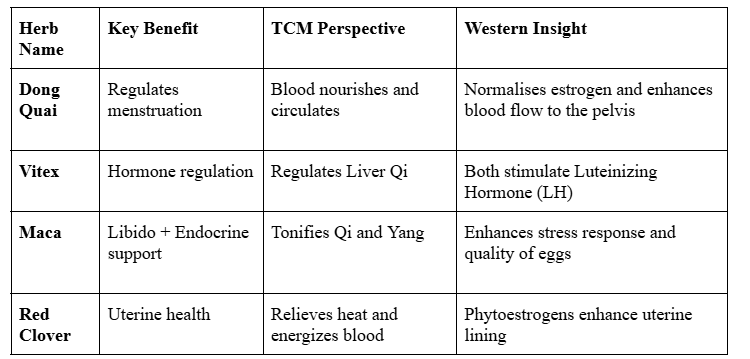
What is Dong Quai (Angelica sinensis) and how does it affect the menstrual cycle? Dong Quai is commonly known as the Female Ginseng, and it is a top blood tonic in Traditional Chinese Medicine. It is traditionally used to nourish and gently move blood, supporting circulation to the pelvic region. It is also very good when one has light periods or when one has a thin uterine lining, as it will be used to nourish the blood that forms that lining every month.
What can Vitex (Chaste Tree Berry) do to promote hormonal balance and ovulation? Vitex is a fertility herb that is probably the most famous in the West. It is believed to act on the hypothalamic-pituitary axis, supporting more balanced hormonal signaling. It has been commonly prescribed to patients whose luteal phase (the interval between ovulation and menstruation) is short or where there is a problem with their cycles caused by PCOS.
What is the role of Maca root in Energy, Libido, and Reproductive Endocrine Health? Maca is an adaptogen of Andean origin, which does not have any hormones itself. Rather, it assists the endocrine system in order to enable the body to produce hormones in a better manner. It works well in increasing libido and handling the exhaustion that usually comes with prolonged fertility therapies.
Why Is Red Clover a uterine tonic for fertility? Red clover contains isoflavones (plant-based phytoestrogens) that may support uterine tissue health when used appropriately. It is also very nutritious with calcium and magnesium in it that relax the nerve system and support the uterus.
Any Herb Combinations in Chinese Herbal Formulas of Fertility?
In Traditional Chinese Medicine, we do not often prescribe a single herb. Instead, we work with classical formulas such as Xiao Yao San to support Liver Qi movement, or Gui Pi Wan to nourish the Heart and Spleen. These are advanced recipes in which herbs act in synergy to reduce the side effects of the herbs and maximize their outcomes.
Instant Guide: Best Fertility Herbs and Functions
What are the Herbs that are used to aid Male Fertility and Spermatozoa Health?
Fertility is a shared process, and sperm health plays an equally important role.
Tribulus Terrestris: This one is known to have the capacity of enhancing Spermatozoa motility (ability to move) and healthy levels of testosterone.
Ashwagandha: Ashwagandha is a very powerful adaptogen that assists in lowering cortisol (stress hormone). A major cause of the high stress is the poor quality of Spermatozoa.
Goji Berries (Gou Qi Zi): Traditional Chinese Medicine, it is used to nourish the Kidney Yin and increase the so-called reproductive vitality. Contemporary studies have shown that they protect Spermatozoa in case of oxidation.
Cistanche (Rou Cong Rong): A Yang tonic which is taken to treat problems with libido and erectile functioning, and also helps in fortifying the Kidney essence.
Herbal is not a one-sided affair in the process of fertility. If you want to enhance your motility or morphology, we will ask you how we can help Spermatozoa health in a more holistic approach to conception.
Does Clinical Research Support the Efficacy of Fertility Herbs?
At Open Care Community, we value both classical tradition and modern research. Clinical interest in reproductive herbal medicine continues to grow.
Vitex and Luteal Phase: According to the studies conducted by the NIH, Vitex would be able to normalize the progesterone levels and raise the chances of pregnancy among women with a luteal phase defect.
Evidence-based review of Maca and Sexual Health: This study demonstrates that Maca can enhance libido and sperm health without necessarily affecting the level of serum hormones.
Goji Berries: Studies indicate that the polysaccharides in Goji berries are capable of preventing heat damage to the testes and oxidative stress, which is traditionally linked to the declining Spermatozoa count.
Self-prescription of These Herbs?
Self-prescribing herbs is strongly discouraged, especially when trying to conceive. An herb that supports one person’s fertility pattern may be inappropriate—or counterproductive—for another.
Potential Interaction of Herbs with IVF Medicine?
Yes. In case you are using an IVF or IUI cycle, some of the herbs may be disruptive to the hormones that your doctor is prescribing. We never conflict with your RE (Reproductive Endocrinologist) at all, so that any herbal assistance is suspended or altered in the active stages of stimulation and transfer of your Western medical treatment.
When Do You Cease Taking Herbs?
Most fertility herbs are discontinued when a positive pregnancy test is obtained, as the requirements of the body are no longer demanded to achieve conception, but rather long-term pregnancy.
Can Open Care Community Support Patients who Use Herbal Medicine to Get Pregnant?
We believe quality fertility care should be accessible. Our sliding-scale pricing ($50–$90) allows patients to receive consistent support without financial strain.
The Expectations of an Herbal Consultation
It is at your herbal consultation that we sit down and view the big picture. We speak about your period, your digestion, your sleep, and your stress levels. Then we prepare a special prescription, whether in powder or capsule form, procured at the respectable dispensaries, which examine the purity and potency of these preparations.
The use of Herbs and Acupuncture
The combination of community or personal acupuncture with herbs has proved the most effective with most of our fertility patients. Acupuncture assists in creating the proper environment by lowering cortisol and raising blood flow, and the herbs in the daily business of feeding your system.
Question: How Long to See Results?
Patience is one of the components of herbal medicine. Due to the usual time frame of 90-120 days of the life cycle of an egg and the subsequent generation of Spermatozoa, we tend to suggest a three-month dedication to your herbal program to begin making noticeable improvements in the quality.
Month 1: It frequently leads to an increase in sleep, digestion, and a lowering of stress levels.
Month 2: You can experience some changes in your menstrual cycle (you have less cramping, more flow, and you can see ovulation better).
Month 3+: It is the sweet spot where the systemic balance that we have been developing starts to have some reproductive results.
Make the Next Move in Your Path
Having a baby is a highly personal process, and you need not go through it alone. Herbal medicine is a way of balancing and empowering, whether you seek a natural option or a therapeutic complement to Western therapies.
Open Care Community is a judgment-free, ADA-compliant clinic at 44 Court Street in downtown Brooklyn—where your story is heard, not rushed.
Be ready to learn about fertility-promoting herbs with advice you can rely on?
Book your fertility-focused herbal consultation today.
FAQs
1. What are fertility-supporting herbs in Chinese medicine?
They are traditional herbal remedies used in TCM to support reproductive health, hormonal balance, and overall wellness related to fertility.
2. How does Chinese medicine approach fertility?
TCM focuses on balancing the body’s energy, supporting organ systems related to reproduction, and promoting overall health.
3. Are Chinese fertility herbs safe?
When prescribed by a qualified practitioner, traditional herbal formulas are generally considered safe and tailored to individual needs.
4. Can fertility herbs help with natural conception?
Some herbs are traditionally used to support reproductive health, though results may vary depending on individual health conditions.
5. How long do herbal treatments take to work for fertility?
In TCM practice, herbal support may be used over several months to help restore balance and support reproductive wellness.
6. Can Chinese herbs be used alongside conventional fertility treatments?
In some cases they may complement conventional treatments, but it’s important to consult a healthcare professional first.
