
What Is the Kidney Meridian in Traditional Chinese Medicine (TCM), and Why Is It Essential for Your Health?
Ever feel completely drained, constantly cold, or low on motivation—even after plenty of rest? These symptoms are more common than you might think.
In Traditional Chinese Medicine (TCM), patterns like chronic fatigue, low resilience, and feeling “burnt out” are often linked to an imbalance in the Kidney Meridian. While it shares a name with the physical kidneys, its role in TCM extends far beyond fluid regulation.
The Kidney Meridian is considered the body’s deep energy reserve—often called the “Root of Life.” It governs long-term vitality, aging, reproduction, and overall constitutional strength. Understanding how this channel functions can help support sustainable energy, hormonal balance, and reproductive health.
In this guide, we’ll explore how the Kidney Meridian works, signs it may be out of balance, and how treatments offered at Open Care Community—such as acupuncture, herbal medicine, and bodywork—can help restore core vitality naturally.
What Is the Kidney Meridian, and How Does It Function in the Body?
In traditional Chinese medicine, the body works like a network - every main organ handles not just bodily tasks but also moods, thoughts, and energy flow. This framework is known as the Zang-Fu theory, which links physical organs with emotional, energetic, and systemic functions.
What does the Kidney Meridian represent in Chinese Medicine?
In TCM, the Kidneys are viewed as the body’s deepest source of vitality. Rather than focusing only on filtration or urine production, Kidney energy is responsible for sustaining life at its most fundamental level.
The Kidneys store Jing, or Essence—your constitutional energy inherited at birth and gradually replenished through rest, nourishment, and care. Jing governs growth, development, fertility, and ageing, making it central to long-term health rather than short-term energy.
The Kidneys help regulate Qi (vital energy) and maintain balance between Yin and Yang. Kidney Yin provides cooling, nourishment, and moisture, while Kidney Yang supplies warmth, movement, and metabolic drive. When these forces fall out of balance, symptoms such as cold limbs, night sweats, exhaustion, or hormonal disruption may appear.
In TCM, maintaining Kidney balance isn’t about extremes—it’s about steady, resilient energy that supports the body quietly and consistently over time.
What’s the link between the Kidney Meridian and energy levels, a longer life, or better sexual function?
The kidneys hold Jing, so they’re tied to how you grow, change, or age over time. Because the Kidneys govern bones and marrow in TCM, they are closely connected to brain function, spinal health, and cognitive clarity. Hair quality, hearing, and reproductive capacity are also considered outward reflections of Kidney health.
This link to core energy turns the Kidney Meridian into a door for reproductive health, along with intimate balance. It controls when puberty starts, how reproductive organs work, and also affects egg and sperm health.
Chronic lower back discomfort might show up when the Kidney Meridian isn't balanced - also, sweating at night could happen. A dip in sexual drive is another clue. Hair may lose color early or get thinner over time. Trouble conceiving? That’s linked too.
Where does the Kidney Meridian travel in the body?
The Kidney Meridian follows a long internal and external pathway, reflecting its role in regulating deep systems throughout the body.
The channel pathway includes:
Beginning on the sole at KD1 (Yongquan)
Traveling along the inner ankle and lower leg (including KD3 and KD6)
Ascending through the abdomen and chest
Internally connecting with the kidneys, bladder, liver, lungs, and heart
Because this channel spans both lower and upper regions of the body, a kidney imbalance can affect everything from lower back pain and fertility to breath, circulation, and emotional resilience.
What Symptoms or Conditions Are Linked to a Kidney Meridian Imbalance?
If your Kidney energy runs low - usually from constant pressure, pushing too hard, poor rest, or getting older - you start noticing signs that hit you at your core.
What are the common signs of Kidney Qi, Yin, and Yang deficiency?
Too much or too little of something usually shows which chemicals are off. At Open Care, practitioners often look for patterns such as:
Persistent fatigue or low stamina
Chronic lower back pain, knee weakness, or joint instability
Tinnitus or reduced hearing
Premature greying or thinning hair
Anxiety or fearfulness (the emotion associated with the Kidneys in TCM)
Night sweats, frequent urination, poor sleep, or temperature sensitivity
Could problems with fertility be connected to imbalances in the Kidney Meridian?
Yes. Your kidneys play a big role in reproduction. How strong your kidney jing is affects things like:
The condition of the ovaries, plus how they change over time.
The chance that an egg is viable plus how strong the sperm is.
The capacity to carry a baby to term.
We often work with people trying IVF while using traditional Chinese methods. Since strong kidney energy supports better bodily conditions for pregnancy, it may help support the body’s readiness for conception and reproductive balance.
If you're checking out different options to help conceive, find out how acupuncture helps IVF while boosting fertility health.
Does adrenal fatigue mean the same thing as weak kidneys in traditional Chinese medicine?
While symptoms commonly described as “adrenal fatigue” overlap with Kidney deficiency patterns in TCM—such as exhaustion, burnout, and reduced stress tolerance—the two frameworks are not identical.
In biomedicine, adrenal fatigue refers to stress-related hormonal dysregulation. In TCM, Kidney deficiency reflects a deeper depletion of constitutional energy affecting stamina, warmth, cognition, and long-term resilience.
That said, many TCM strategies used to nourish Kidney Yin, Yang, and Jing—such as acupuncture, herbal therapy, and lifestyle modification—are often used to support recovery after prolonged stress.
How Does TCM Help Rebalance the Kidney Meridian?
In the Open Care Community, fixing your Kidney imbalances is unique - each path rebuilds core strength based on your own needs.
How is acupuncture used to strengthen the Kidney Meridian?
Needles can wake up the kidney pathway, helping your system recharge naturally - this method sparks self-healing by targeting key zones. Instead of adding outside fixes, it uses your inner flow to boost vitality from within.
Some spots along the pathway - like KD3, or Taixi, close to the inside ankle - help support Yin and deep energy.
Ren4, found in the lower belly area, plays a big role in boosting what’s called Yuan Qi, your core vitality.
Personal care starts with real understanding - our team looks past surface issues. Instead of focusing on one sign, we check deeper imbalances like weak kidney energy, low warmth, or tired essence. That way, solutions fit who you really are. Each plan shifts based on what your body tells us.
Need help with low energy or kidney health? Try acupuncture now - pick a kind therapist from our team. Healing’s within reach, thanks to our flexible $50– $90 rate.
What herbal remedies nourish Kidney Yin, Yang, and Jing?
Chinese herbal medicine is often used alongside acupuncture to support deeper, systemic rebalancing. When it comes to restoring weak Kidney energy, certain plants naturally target that area. Some herbs just fit right into how the body’s systems operate, making recovery deeper and smoother over time.
When it comes to Kidney Yin, Rehmannia (Shu Di Huang) often helps by adding moisture while calming heat.
For Kidney Yang: Warming herbs like Eucommia Bark (Du Zhong) can help restore the internal "fire."
Jing is supported with herbs, such as Goji Berries, for example, that boost liver function while also strengthening the Kidneys to restore vital essence. Instead of just treating symptoms, they work deep down where it matters most.
Our licensed herbalists give herbal advice tailored to your unique needs, so you get a mix just right for how you feel.
Can cupping or Gua Sha support Kidney Meridian health?
Yes. Though acupuncture works on inner energy, hands-on treatments usually target the actual signs tied to the kidney area.
Cupping or Gua Sha helps clear blockages in the lower back - this region links to the Kidneys. These methods also loosen stiff muscles using gentle pressure instead of force. Cupping works with suction. Gua Sha uses a scraping motion across the skin surface. Each targets tension right where it sits, avoiding general approaches. Results often appear quickly once flow improves beneath the surface.
Tui Na, a type of Chinese healing massage, works by clearing energy channels while boosting Qi - great for people dealing with ongoing tiredness.
These techniques are often integrated into acupuncture sessions based on individual presentation—your practitioner can advise whether they’re appropriate for you. If you book a private session at Open Care, we can do acupuncture and another modality. In community acupuncture, you must book two sessions if you want cupping or Gua sha. We recommend talking to your practitioner to determine what makes sense for you.
What Lifestyle Changes Can Support Your Kidney Meridian?
The kidneys drain fast when you push yourself too hard or feel constant pressure. Acupuncture or herbal fixes won't fix habits that keep wearing you down. Here's the bright side - tiny steps, done regularly, shift things big time.
What’s the link between downtime, daily habits, and stronger kidney function?
In TCM, rest is considered essential nourishment for Kidney energy.
The TCM body clock shows sleeping by 11 PM helps your lungs clear out toxins - then the liver gets to work, protecting kidney energy.
Avoid burnout: when you push too hard, mentally or physically, your kidneys take a hit. Try pausing now and then; quiet moments aren’t lazy, they’re fuel for your inner reserves.
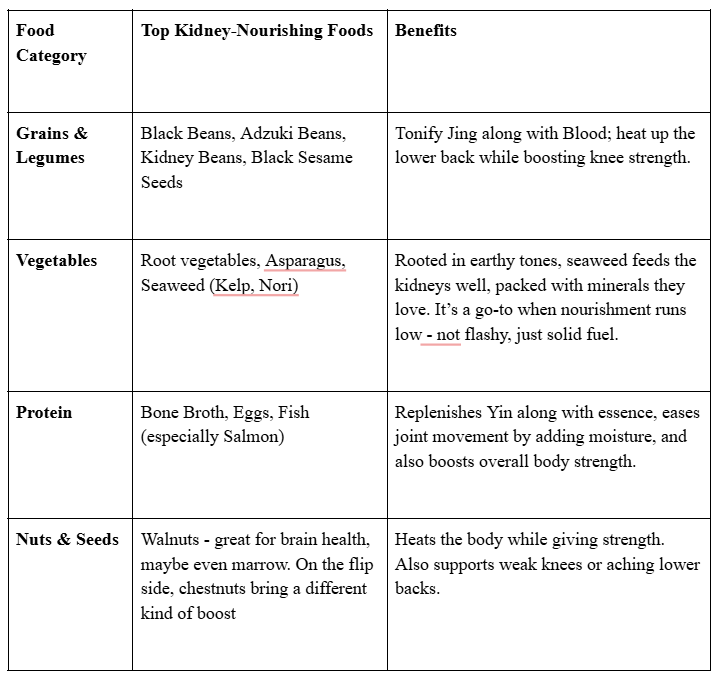
Do certain foods help support kidney function?
Dietetic picks helping the kidneys are often warm, rich in color, full of sustenance - meals tied to the Water aspect.
How does winter affect your kidney meridian health?
In traditional Chinese medicine, winter ties closely to water plus the kidneys. During this time of year, it’s perfect for serious downtime, quiet thinking, or restoring energy.
Winter isn't about kicking off fresh plans. It’s more like feeding your body's deep storage. The Kidneys use this season to recharge quietly. Think of it as restocking energy when things slow down outside.
Eating warm meals, while also focusing on solid rest, gives real benefits when temperatures drop.
How Can You Get Personalized Help for Kidney Meridian Issues at Opencare?
If you're dealing with constant tiredness, lower back aches, trouble conceiving, yet feel on edge, your Kidney Meridian might need some help.
Why choose an integrated, affordable TCM clinic in Brooklyn?
We're convinced - healthcare belongs to everyone, yet good personalized treatment isn't just for those with money.
Open Care Community brings low-cost health care straight to downtown Brooklyn, New York. Instead of fixed fees, we use a flexible rate - anywhere from $50 to $90 each visit. No proof of earnings needed, just honesty about what you can afford. Built on mutual respect, our system lets you choose your payment freely. We’re here to help people heal over time without financial stress.
How are treatment plans tailored at Opencare?
Your whole approach to advice makes sure care fits you perfectly - while giving you control step by step.
First up, we check how you're feeling by asking what’s been going on and reviewing your health history forms (intake paperwork).
Then, we look at your tongue - yeah, that part matters more than you’d think.
After that, we feel your pulse; it tells us a lot about what's out of balance.
From all this, we figure out your unique pattern - like if it’s Kidney Yin or maybe Kidney Yang that’s off.
Your protocol might mix acupuncture with herbs prescribed for you, while adding techniques such as Gua Sha or cupping to focus on key areas.
We work alongside you - sharing simple tips on food and daily habits that help speed up recovery, so you stay involved, aware, tied into your progress without confusion or fluff.
How do reviews describe help with Kidney Meridian troubles?
We’re glad to help folks in Brooklyn and across the city regain that core energy they’ve lost:
Ready to Restore Your Root of Life?
Chronic fatigue, hormonal imbalance, and burnout don’t have to be your baseline. With consistent, accessible care, it’s possible to rebuild energy from the inside out.
👉 Explore Our Sliding-Scale Acupuncture Services
👉 See Pricing & Treatment Options
FAQs
1. What is the Kidney Meridian in Traditional Chinese Medicine?
The Kidney Meridian is an energy pathway in TCM believed to regulate vital energy (Qi) and support essential functions related to vitality and balance.
2. Why is the Kidney Meridian important for health?
In TCM theory, it is associated with foundational energy, growth, and the balance of many body systems.
3. Where does the Kidney Meridian run in the body?
The Kidney Meridian is believed to begin on the sole of the foot and travel upward through the inner leg and torso.
4. What symptoms may indicate imbalance in the Kidney Meridian?
TCM practitioners may associate fatigue, weakness, or imbalance in certain body systems with disruptions in Kidney Meridian energy.
5. How can the Kidney Meridian be supported?
Practices such as acupuncture, acupressure, herbal medicine, and balanced lifestyle habits may help support the meridian.
