What are the 5 Elements in Chinese Medicine, and How Do They Impact Your Health?
Have you ever wondered why your acupuncturist asks about your sleep, digestion, and feelings—and even which seasons you love or hate? The reason usually lies in the incredible depth of the Five Elements, a prominent aspect of Traditional Chinese Medicine (TCM). This ancient system is not just a philosophical idea; it is a model that practitioners use to help navigate the connections between your body, your mind, and the outside world.
In TCM, the Five Elements are Wood (木, mù), Fire (火, huǒ), Earth (土, tǔ), Metal (金, jīn), and Water (水, shuǐ). You may begin to group them as seasons since they represent phases of interaction or dynamic, energetic archetypes of every natural phenomenon imaginable, including the seasons and the organs of the body.
This article is here to explain the Five Elements in the least complicated, most genuine way. We will examine the elements represented, how they interact with one another, and how they are expressed within your own health patterns. Here at Open Care Community, our practitioners use this ancient knowledge on a daily basis in service to our patients here in Brooklyn in pursuit of balance and healing, and we are excited to share that body of wisdom with you!
Wondering how the 5 elements could explain your existing symptoms or guide your healing process? Book a customized consultation with us at Open Care Community in Brooklyn.
How are the 5 Elements represented in Traditional Chinese Medicine?
In Traditional Chinese Medicine (TCM), the Five Elements are a holistic framework used to understand health. It is a framework from which we view the relationships of health, how various body systems influence one another, and the interaction that you, as an individual, have with the environment.
Where do the 5 Elements come from?
The Five Element Theory has been referenced for thousands of years and can be traced back to Classical Chinese philosophy. The theory can be found in texts like the Huangdi Neijing (The Yellow Emperor's Classic of Internal Medicine) from the Han dynasty. The 5 elements grew alongside the equally foundational idea of Yin and Yang, which denoted the two opposing yet complementary forces of the universal phenomena of life.
In contrast to Yin-Yang's duality, the Five Elements offer a more nuanced framework of relationships and transformations; furthermore, it provides another, deeper layer for diagnostics.
What are the 5 Elements, and how do they relate to the organ systems of the body?
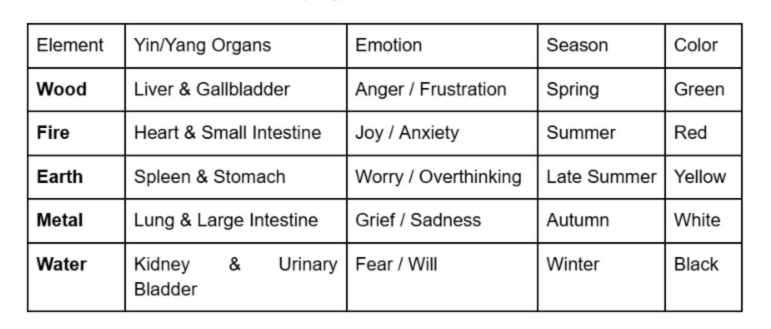
Each element corresponds to a collection of organ systems, emotions, seasons, colors, and even tastes. This allows for the identification of patterns. If, for instance, a patient is experiencing an overall health problem during the spring season, the practitioner may want to examine the Wood element for any signs of imbalance.
How do practitioners apply this knowledge in treatment?
A TCM practitioner uses this structure to look for patterns of disharmony. By listening to your story, observing your complexion, and feeling your pulse and tongue, a practitioner may explore which element may not be in a state of balance.
For example, we may have a patient who is constantly worrying and deals with chronic digestive issues like bloating (both indicators of an Earth imbalance). This pattern may be diagnosed with what we refer to as "Spleen Qi Deficiency." Treatment may focus on strengthening the Earth element through specific acupuncture points, herbal options selected from pre-set formulas, when appropriate.
What do each of the elements represent physically, emotionally, and energetically?
Let’s consider each element's personality and how that might show up in you.
Wood Element - Growth and Flexibility
The Wood element represents spring, growth, expansion, and forward motion. It contains the energy to plan, make decisions, and allow for the free flow of your Qi (vital energy).
Physically Governs: Liver, Gallbladder, muscles, tendons, and eyes.
Emotional Elements: A balanced Wood element allows for assertiveness and vision. When imbalanced, it expresses anger, irritability, and frustration.
Signs of Imbalance: Tightness in the neck and shoulders, tension headaches, irregular menstrual cycles (such as PMS), teeth grinding, and a feeling of being "stuck."
Treatment Example: Acupuncture protocols that calm the Liver and support the smooth flow of Qi, using herbs that support smooth flow and flexibility.
Fire Element - Consciousness and Connection
Fire is the summer element that represents the fullness of energy, warmth, consciousness, and connection. Fire is associated with the Heart, which is where the Shen (spirit and mind) is housed.
Paired Organs: Heart, Small Intestine, Pericardium, and the San Jiao (Triple Burner).
Balanced Emotions: In harmony, Fire can bring happiness, passion, and balanced relationships. An unbalanced Fire can manifest as anxiety, restlessness, insomnia, or feeling emotionally withdrawn.
Signs of Imbalance: Disturbed sleep, palpitations, anxiety, excessive sweating, and a red complexion.
TCM Approach: The TCM approach is often to calm the Shen and address signs of excess heat in order to support emotional steadiness.
Earth Element - Nurturing and Digestion
The element of Earth is about nourishment, support, and transformation. Like a fertile field, it regulates how we digest food, thoughts, and experiences, and turns them into nourishment for our bodies and minds.
Regulates: Spleen and Stomach, which are the center of our digestive system in TCM.
Emotional Aspect: A healthy Earth element allows one to feel supported, grounded, and stable. When Earth is out of balance, you may experience worry, excessive thinking, and obsessive thought processes.
Physical Signs: Bloating, loose stool, poor appetite, fatigue (especially after eating), sugar cravings, and weakness.
Strategies: Treatment often works to strengthen the Spleen Qi using acupuncture, and nourishing, easy-to-digest foods.
Metal Element - How Can You Let Go and Protect at the Same Time?
The symbol for Metal is the season of autumn. It represents shape and structure, boundaries, and the ability to lose things that no longer serve you, as trees shed leaves. Metal also represents protection from the outside world.
Organs: Lung and Large Intestine.
Deals with: Grief, boundaries, and defensive Qi. When Metal is balanced, we can grieve loss while still maintaining healthy self-worth. When it is out of balance, grief is prolonged, letting go is hard, and there is rigidity.
Related Conditions: Asthma, frequent colds, respiratory allergies, skin problems (eczema), and constipation.
TCM Concepts: Our Metal element health is associated with Protective Qi (Wei Qi), the first level of defense we have against external influences.
Water Element - What Do Fearless and Deeply Rooted Feel Like?
Water is our deepest source, our battery pack. It rules our core reserves, willpower, and endurance in the winter. It is where we hold our Jing, or constitutional essence, that is associated with vitality and resilience over time.
Organs: Kidney and Urinary Bladder.
Emotional Cue: A well-resourced Water element provides persistence, willpower, determination, and wisdom. When deficient, it shows up as fear, insecurity, and a lack of determination and drive.
Symptoms: Lower back pain, knee problems, issues with hearing, fertility problems, and exhaustion that is not relieved through sleep.
TCM Practice: A lot of treatments may include approaches that support Kidney energy and strengthen our Water element to replenish our first reserves.
At Open Care, we create individualized acupuncture sessions and pre-set herbal options for your element imbalances. Want to feel more grounded, rested, or energized? Let us identify your element and get you feeling balanced. Book a session today.
How Do These Elements Interrelate With One Another?
The Five Elements do not exist in a vacuum—they are always interrelating in two major ways: the Generating Cycle and the Controlling Cycle. A healthy body is always balancing these two interactively.
What Is the Generating Cycle (Sheng Cycle)?
The Sheng Cycle is also known as the "mother-child" cycle and describes how each element nourishes and enhances the next element, flowing clockwise around the circle.
Wood feeds Fire (wood makes fire).
Fire makes Earth (ash, after a fire, becomes earth).
Earth makes Metal (we mine metal from the ground).
Metal holds Water (water coalesces on Metal).
Water nourishes Wood (water allows trees to grow).
An imbalance in the Sheng Cycle may mean that an element does not nourish its "child," and the parent's deficiency would then develop downstream.
What Is the Controlling Cycle (Ke Cycle)?
The Ke Cycle, or "grandmother-grandchild" cycle, describes how the controlling element keeps its child in line (to prevent overacting).
Wood controls Earth (tree roots capture the soil).
Earth consumes Water (Earth is both the dam and the drainage path for water).
Water controls Fire.
Fire controls Metal.
Metal controls Wood.
If a particular element becomes too strong (overacting) or too weak (being overacted upon), then this regulatory relationship breaks down, with a possibility of symptoms developing.
Frequently Asked Questions
1. Can lifestyle or life experiences trigger element imbalances?
Yes. In fact, this is the most common cause. Chronic stress, nutritional imbalances, ongoing emotional stress, and even excessive seasonal change can throw off the balance of your elements. For example, if a patient is dealing with a significant loss, they might have a metal imbalance, as indicated by their shallow breathing, weak immune function, and ongoing distress at the experience—patterns sometimes associated with the Lung (Metal) system working through the experience.
2. How can I identify which element might be out of balance?
Although a practitioner will offer a more complete assessment, you might notice patterns for yourself.
3. What are the lifestyle or emotional patterns associated with the elements?
Wood: Typically a "Type A" personality, a natural leader and planner. Stressed and feeling restricted.
Fire: The socialite loves to connect and converse. Can be emotionally erratic.
Earth: The nurturer, always taking care of others. Stressed and neglecting their own needs.
Metal: Very structured, organized, and disciplined. Could be perfectionistic in nature and struggle to move on.
Water: The philosopher, introspective and driven. A workaholic who may struggle to know their own limits.
4. How can a practitioner assist you in identifying your constitutional element?
A trained acupuncturist or herbalist can utilize diagnostic methods that have been developed over centuries. They will begin to notice your elemental patterns based on conversations about your health and life. We also really value the use of physical diagnostics like tongue diagnosis (which informs us of color, shape, and coating) and reading your pulse (which allows us to feel the quality and nature of your pulse in specific locations on your wrist). These physical diagnostics provide us with additional insight into current patterns of what is happening in your organ systems.
Identify your Element and learn how to live in attunement with it. Our practitioners can assist you with deciphering what potential areas are asking for rebalancing in your body, mind, or spirit. Book a consult today at Open Care Community, even if you are not a member yet!
How Can the 5 Elements Help You to Feel More In Tune, Season to Season?
One of the fundamental ideas of Five Element theory is living in alignment with the seasons. Each season is an opportunity to nourish the related element.
What lifestyle changes can support each element?
Spring (Wood): A time for new beginnings. Stretch out your body, start new projects, eat leafy greens, and be in nature.
Summer (Fire): Relish happy activities and community. Drink plenty of water and eat cooling foods, like watermelon. Protect from sunburn and sun damage.
Late Summer (Earth): Nourish and harvest from the earth. Eat warm and cooked foods (soups and stews do the best) and take time to ground and reflect.
Fall (Metal): A time for letting go. Clean and declutter your home, and do a gratitude journal to process your feelings from all that you have created in the year. Take time for deep breathing exercises to facilitate the Lungs.
Winter (Water): A time for rest, renewal, and to slow down. Go to bed, use slow connected movement like yoga, and eat warming, nourishing foods (black beans, bone broth) to preserve deep energy reserves.
Final Thoughts: A Compassionate Approach to Healing to know the Five Elements is more than understanding it cognitively; it is an act of being compassionate towards yourself by being able to articulate your health. It teaches us that your physical, emotional, and energetic states are all integrated. A tight back may reflect more than muscle tension alone; it might be your Wood asking you to be more flexible. Anxiety may be experienced physically and emotionally; it may be your Fire needing to be soothed. This system, which has been utilized for thousands of years, helps you to see your body as an entire dynamic ecosystem instead of a splinter of parts.
Ready to take the leap over your body, emotions, and energy? No matter if you are dealing with seasonal allergens, stress, or fertility, we are here to help you reconnect with your elemental balance. Schedule your visit today at Open Care Community.
