What does the heart mean in Chinese medicine?
What comes to mind when you think of your heart? Most of us who have been raised in a Western worldview imagine a powerful, muscular pump that tirelessly pumps blood through our bodies. Often viewed as the engine of our physical being, it is understood in biological and mechanical terms.
However, in Traditional Chinese Medicine (TCM), the Heart symbolizes much more than that. It is symbolically referred to as the emperor, or sovereign, of the entire body. The Heart does not only circulate blood; it also governs our consciousness, our emotional well-being, and our spirit. It is the residence of our awareness and the source of inner peace and tranquility.
At Open Care Community, we encounter many patients who are physically well but feel emotionally drained, unsettled, or disconnected. When we look at the Heart, we can start to see that true wellness, from the perspective of Chinese medicine, includes nourishing this inner balance.
What Does the Heart Govern In Chinese Medicine?
In TCM, every organ has functions that go beyond its physical anatomy. The Heart is the ultimate example of this holistic conception of organs, playing a central role in our mental and emotional life.
Does the heart control more than the way in which we circulate blood?
Yes, absolutely. The Heart's primary function is to deliver and store blood, but its greatest function is as the vessel of the Shen (神). The Shen is a complex concept often translated as spirit, mind, or consciousness. It is the light in our eyes, the clarity and acuity of our thinking, and the presence we exude in the world.
When you have a calm Shen, anchored in the Heart, you can feel emotionally stable, you sleep well, and think clearly. When Shen is disturbed, it can cause you to feel anxious, have a racing mind, or feel restless. The state of your heart is connected to the state of your mind.
How Does the Heart Relate to Mental and Emotional Health?
Because the Heart is where the Shen resides, it is the center of our emotions and mental processes. In Chinese medicine, experiences such as anxiety, insomnia, vivid dreaming, or difficulty concentrating are sometimes understood in TCM as related to Heart imbalance. The Heart influences our sleep quality, our ability to create emotional bonds, and our capacity for happiness.
Which Organs Work Closely With the Heart in TCM Theory?
No organ works in isolation. Associated with the Fire element, the Heart is closely related to the Small Intestine, which distinguishes the pure and impure. This is true for both the physical and the mental. The Heart also has a close relationship with several other major organs:
The Liver: The Liver facilitates the smooth flow of qi (your energy) throughout the body. If stress causes Liver qi to stagnate, it may affect the Heart and cause irritability.
The Kidneys: Associated with the Water element, the Kidneys help provide balance to the Heart's Fire. A strong relationship between the Kidneys and Heart is essential to balancing fear and anxiety, as well as facilitating restful sleep.
What Are Some of the Leading Symptoms of a Heart Imbalance?
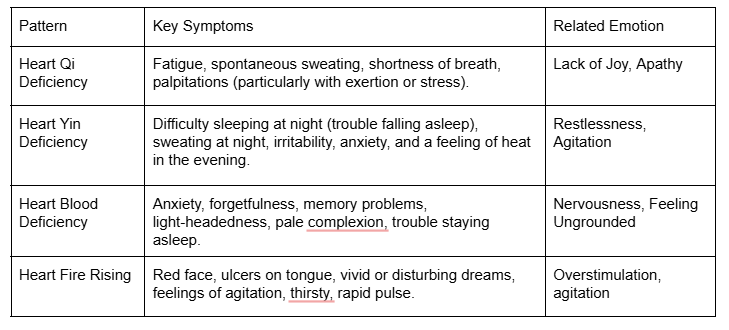
There may be both subtle and severe ways that an imbalance can present for a patient in your care; a practitioner at Open Care Community will examine your assembly of symptoms for a definitive pattern of disharmony.
How Will You Know If You Have a Deficient or Disturbed Heart Qi?
Here are some potential patterns of Heart imbalance; please see if any of these touch upon your individual experience:
What Emotions are associated with the Heart in Chinese Medicine?
Joy is the emotion associated with the Heart. When the heart is balanced, we feel an experience of gentle stability with happiness and contentment, beyond just pleasantness and joy. There is a sense of steadiness and contentment. The imbalance can swing two different ways; a deficiency will lead to sadness, depression, and a lack of enthusiasm for life, while excess joy, mania, or being overjoyed, will "scatter the energy of the Heart," allowing for agitation and potentially leading to restlessness.
How does Chinese Medicine strengthen or balance the Heart?
The focus of treatment is to support the Heart gently, calm the Shen, and restore harmony. At Open Care Community, we incorporate a few different time-tested therapies in your treatment plan based on your particular constitution.
Which Acupuncture Points are Helpful for Heart Health?
Acupuncture is a transformative therapy for relaxing the mind and calming the spirit. Your acupuncturist may use acupuncture points such as:
Heart 7 (Shenmen or Spirit Gate): Located in the wrist creases, this is a key acupuncture point for calming anxiety and supporting sleep quality.
Pericardium 6 (Neiguan or Inner Pass): Located on the inner forearm, this point can help regulate the Heart, relieve heart palpitations, and calm nausea or tightness in the chest caused by emotional stress.
Are you ready to achieve a feeling of calm? Acupuncture can be a profoundly restorative approach to working with your emotional health. Book a Heart-focused session today at Open Care Community.
Can Chinese Herbs Help with Heart Imbalances?
Herbal medicine is another fantastic way to support nourishment from the inside out. These formulas are prescribed based on your specific pattern. For instance, a patient with Heart Yin Deficiency who has insomnia might be prescribed a formula like Suan Zao Ren Tang, which nourishes blood and yin to calm the spirit. The important thing is to work with a trained herbalist who can recommend an appropriate formula based on your individual presentation.
What Role Do Sleep, Nutrition, and Lifestyle Play?
Everyday habits can make a significant difference in Heart Health.
Sleep: Aim to be in bed by 11 PM. In the TCM clock, the Gallbladder governs the hours from 11 PM to 1 AM, and being asleep helps the Heart to regenerate.
Nutrition: Consume foods that nourish the heart and blood. The following foods are traditionally associated in TCM with nourishing Heart blood: cooked beets, dark leafy greens, dates, and lean protein sources. Red foods are commonly seen as nutritious for the Fire element.
Movement: Practices such as Qi Gong and Tai Chi, or even walking in nature, provide gentle movement to calm the Shen and move stagnant energy without overexciting the system.
How Does the Heart Fit into the Five Element Theory?
In TCM, we understand the universe and nature's relationship using the five elements: Wood, Fire, Earth, Metal, and Water. The Heart is part of the Fire element and is associated with summer, warmth, consciousness, and connection.
The five elements are always interplaying in support and control of each other.
Wood feeds Fire: The Liver (Wood) provides a smooth flow for energy to support the Heart (Fire).
Water controls Fire: The Kidneys (Water) provide a grounding for the Heart's fire from flaming out of control, which helps with anxiety.
This is why TCM practitioners will always look at your whole system, and not just at a symptom.
How Do TCM Practitioners Diagnose Heart Imbalances?
When you come for a session, we listen deeply to your story, and we also employ diagnostic tools that have been refined over centuries.
Pulse Diagnosis: By feeling the pulses on your wrists, a practitioner can assess the state of your Heart's energy.
Tongue Diagnosis: The tongue is a map of the body. A red tip typically points to Heart Fire; a pale tongue can indicate Heart Blood Deficiency.
Holistic Consultation: Most importantly, we talk. We connect your physical symptoms to your emotional state, your level of stress, as well as your daily activities. This gives us the ability to see the root cause of disharmonies.
Are you curious about what your body is telling you? A private acupuncture or herbal consultation can help you understand your unique energy patterns. You can book a consultation here.
Can TCM support cardiovascular conditions used in Western Medicine?
Chinese medicine can be a useful adjunct to Western cardiology. Research has indicated that acupuncture may support overall relaxation and stress management, diminish palpitations, and improve sleep quality in those with cardiovascular-related issues. We believe in a model of integrative care. We want to support you in being well overall, relieving the stress of care, and helping to address energetic imbalances contributing to your condition, all while you are under the care of your medical doctor.
What does heart-focused healing mean in Chinese medicine?
To heal the heart in Chinese medicine is to heal the whole person. It is about calming the spirit, nourishing the body, and making room for emotional release. It is a return to the knowledge that the Heart is the emperor, and when the emperor is calm and centered, the entire kingdom of the body can be harmonious.
At Open Care Community, this philosophy is foundational to everything we do. We believe patient empowerment comes from being cared for as a whole person—mind, body, and spirit. Your emotional and spiritual health are just as important as your physical health.
We're here to offer comfortable, compassionate, and human-first care to you.
Your journey toward a more harmonious and peaceful self starts now. We would love for you to book an acupuncture session focused on your heart. Begin finding your place with Open Care Community.
FAQs
1. What does the Heart represent in Chinese medicine?
In TCM, the Heart represents consciousness, emotions, mental clarity, and vitality, not just circulation.
2. What is the Shen in Chinese medicine?
The Shen refers to the mind and spirit. It resides in the Heart and influences sleep, memory, emotional stability, and awareness.
3. What emotions are associated with the Heart?
The primary emotion of the Heart is joy. Imbalance may lead to anxiety, restlessness, or excessive emotional sensitivity.
4. How does the Heart affect sleep in Chinese medicine?
A balanced Heart supports deep, restful sleep. Heart imbalances are often linked to insomnia, vivid dreams, or frequent waking.
5. What causes Heart imbalance in TCM?
Common causes include chronic stress, overwork, emotional strain, poor diet, and lack of rest.
6. How is the Heart supported in Chinese medicine?
TCM supports Heart health through acupuncture, herbal medicine, calming foods, breathwork, and emotional regulation.
