
Trigger Point Therapy in Brooklyn: Targeted Pain Relief
What Is Trigger Point Therapy and How Can It Relieve Chronic and Acute Pain in Brooklyn?
Brooklyn moves fast. Whether you’re commuting on the Q train, working long hours at a desk in DUMBO, or training for the New York City Marathon, the body often absorbs that pace. Over time, this stress can show up as stubborn “knots”—persistent tightness in the neck, shoulders, or lower back that doesn’t seem to resolve, even with stretching or rest.
If you’ve already tried foam rolling, stretching, or different types of massage and still feel that nagging pain, you’re not alone. At Open Care Community, we regularly work with people living with both acute and chronic pain. We take pain seriously, listen closely, and treat it as meaningful information rather than something to push through or ignore. Trigger Point Therapy is one of the targeted, evidence-informed bodywork approaches we use to address these specific knots. Rather than focusing only on surface relaxation, this method works directly with the underlying points contributing to ongoing discomfort.
Our goal is to offer high-quality, compassionate care that remains accessible. We believe cost and clinical detachment should never stand in the way of care that feels supportive and human.
If you’re curious about whether trigger point therapy could help with your pain, our team at our Brooklyn clinic is here to support you.
How Does Trigger Point Therapy Work to Release Pain?
What are trigger points, and why do they bring about pain?
Simply put, trigger points are often referred to as muscle knots. They are hyperirritable foci that are found clinically in a tight band of muscle. Muscles that remain tight due to repetitive strain, poor posture (such as “tech neck”), or prolonged stress may experience reduced blood flow. This local lack of oxygen can activate pain-signaling pathways in the nervous system.
A particularly striking characteristic of trigger points is referred pain. For example, a trigger point in the neck can cause pain or numbness in the hand, and a trigger point in the hip can cause pain that runs down the leg. By identifying and working with these specific points, practitioners aim to reduce pain closer to its source rather than only managing symptoms.
What is the difference between trigger point therapy and other methods of massage or bodywork?
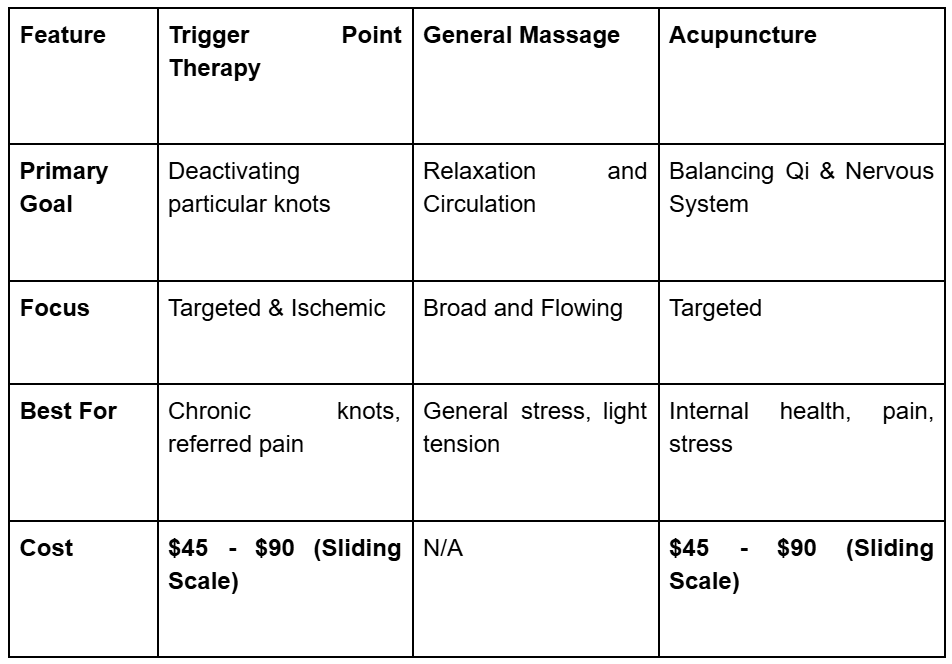
While traditional Swedish massage supports general relaxation and circulation, it typically does not focus on highly specific areas of muscular dysfunction. Trigger point therapy is more focused and local.
General Massage: Uses long, flowing movements designed for overall relaxation.
Deep Tissue Massage: Works with deeper muscle layers but often addresses broader areas.
Trigger Point Therapy: Applies sustained, targeted pressure or stretch-release techniques to specific points associated with pain.
At Open Care Community, trigger point therapy is often integrated with other bodywork approaches, such as Tui Na (traditional Chinese medical massage) and Gua Sha, to support the musculoskeletal system more comprehensively.
What to Expect at Open Care Community
We understand that clinical settings can feel intimidating. That’s why we focus on creating a calm, non-judgmental environment in our downtown Brooklyn clinic. Your practice begins with a conversation; we are looking to know your medical history, as well as localize your tension.
During the intervention, the practitioner will feel your musculature to find the exact nidus of the knot. As pressure is applied, you may notice a sensation often described as “productive” or “intense but manageable,” signaling muscular release. Our trauma-informed approach emphasizes the following principles:
We proceed at your pace.
We constantly assess levels of comfort.
We aim to empower you during the experience.
Who May Benefit Most From Trigger Point Therapy in Brooklyn?
What types of pain and conditions have the highest level of responsiveness?
This modality is widely used for a range of musculoskeletal concerns. It is particularly useful in:
Neck and Shoulder Pain: Usually caused by bending down over laptops or phones.
Lower Back Pain: Common with tight gluteal or hip flexors.
TMJ/Jaw Tension: The masseter muscle has trigger points that can provide significant relief to those who grit their teeth.
Sciatica and Hip Pain: Releasing the piriformis muscle can tend to relieve neuropathic pain in the legs.
Is trigger point therapy safe for athletes, fertility patients, and chronic pain patients?
Indeed. We tailor the pressure and technique to individual needs:
Professional Athletes: We promote rehabilitation and increase the range of motion.
Fertility Patients: In patients undergoing IVF treatments, the focus is on the reduction of systemic stress and protection of the abdominopelvic areas.
Sufferers of Chronic Pain: We adopt a gradual approach through subtle methods because of the hyperirritability of the nervous system in chronic cases.
Does trigger point therapy contribute to stress and mental wellness?
The principle of Qi stagnation often comes up in Traditional Chinese Medicine (TCM). Once Qi—or bodily energy—is clogged, it is commonly expressed as physical tightness. When loosening up these physical knots, the nervous system is sent an alert that it is safe to enter a "rest and digest" mode, rendering great mental and emotional stress relief.
What Science Tells Us About Trigger Point Therapy
Are trigger points real? What does research show?
Although knots were once considered a subjective feeling, modern imaging techniques, including MRI and ultrasound, have established their existence. Myofascial Pain Syndrome (MPS), the clinical term often used to describe chronic trigger point pain, is widely discussed by the National Institutes of Health (NIH) as a significant contributor to ongoing musculoskeletal discomfort. Similarly, Harvard Health Publishing has discussed trigger point therapy as a commonly used approach for managing localized muscle pain and improving mobility.
Clinical evidence of effectiveness
The literature constantly shows that selective manual trigger point pressure results in:
Greater Range of Motion: Once the knot has been released, muscles can lengthen entirely.
Less Pain Intensity: Patients often report a significant decrease in pain on the pain scale immediately after treatment.
Reduced Reliance on Medication: Many individuals find they require fewer over-the-counter analgesics after several sessions.
Pricing and Accessibility in Brooklyn
Is trigger point therapy affordable at Open Care Community?
We believe healthcare should be accessible and community-centered. We offer Community Bodywork and Acupuncture services with a sliding scale of $50 to $90. There is no income verification or documentation required; we trust our patients to pay an amount that is sustainable for them.
Comparison of Care Modalities
Get to Know Community-Centered Healing
Open Care Community is a home to Brooklyn residents who want to receive relief and attention. Whether you are an experienced sports star or a novice to alternative therapies, you are welcome here.
Ready to start your healing journey?
